

The UK logistics and supply chain sector is undergoing structural transformation. From post-Brexit customs adjustments to fuel price volatility and the continued surge of eCommerce, operational complexity has increased significantly over the past few years. Ports such as Felixstowe and major distribution hubs across England are processing higher volumes while facing tighter regulatory oversight and growing customer expectations for same-day or next-day delivery.
For logistics companies in the UK, this shift is not just about scaling capacity — it is about gaining real-time operational intelligence. Shipment tracking, warehouse inventory, fleet movement, customs clearance, and supplier coordination must now function as a connected ecosystem rather than isolated systems. However, many organisations still rely on legacy ERP platforms and batch-processing workflows that were not designed for modern supply chain velocity.
This is why industry leaders are moving toward cloud-native, event-driven architectures that can process operational events instantly. A delayed shipment in Birmingham should automatically trigger route recalculations. A customs status change should update warehouse dashboards immediately. A stock threshold breach should initiate procurement workflows without manual intervention.
As a result, UK logistics firms are increasingly evaluating long-term technology transformation strategies rather than one-off IT upgrades. Whether they are exploring collaboration with a logistics digital transformation consultancy in the UK, an event-driven architecture company UK, or a cloud infrastructure agency specialising in supply chain modernisation, the priority is clear: build systems that respond in real time, scale predictably, and remain resilient under peak demand.
The competitive advantage in UK supply chain operations is no longer determined by physical infrastructure alone. It is now defined by architectural agility — the ability of technology systems to react, adapt, and optimise continuously. Event-driven design is emerging as the foundational approach enabling this next phase of logistics evolution.
Why Traditional Supply Chain Systems Are Failing in the UK
Despite rapid growth in digital commerce and cross-border trade, many UK logistics and supply chain organisations continue to operate on legacy ERP platforms and tightly coupled software environments. These systems were originally built for predictable workflows — not for the dynamic, real-time demands of modern distribution networks.
Traditional architectures rely heavily on batch processing. Inventory updates may occur every few hours. Shipment status changes may sync overnight. Financial reconciliation and customs documentation may move through multiple manual checkpoints before becoming visible across departments. In a fast-moving logistics environment, these delays create blind spots.
For example, if a shipment is delayed at a UK port due to customs clearance issues, warehouse teams may not receive that update immediately. Fleet managers may continue planning routes based on outdated arrival schedules. Customer service teams may only learn of disruptions when complaints begin to surface. The system reacts — but it reacts too late.
Another challenge lies in fragmented technology stacks. Warehouse Management Systems (WMS), Transport Management Systems (TMS), CRM tools, and finance platforms often operate in silos, connected through rigid APIs or manual exports. This leads to integration bottlenecks and operational inefficiencies. As supply chain networks scale, these bottlenecks compound.
Scalability is also a concern. During peak retail seasons in the UK — such as Black Friday or Christmas — infrastructure built on static provisioning struggles to handle traffic spikes. Over-provisioning leads to wasted cloud spend, while under-provisioning risks downtime. Many organisations exploring collaboration with a cloud infrastructure company in the UK or a logistics IT consultancy UK are primarily seeking to address this imbalance.
Security and compliance risks further expose the limitations of monolithic systems. GDPR requirements, supplier data sharing, and cross-border trade compliance demand secure, auditable, and resilient systems. Legacy architectures were not designed with zero-trust models or distributed cloud environments in mind.
Ultimately, traditional supply chain systems fail not because they lack functionality — but because they lack responsiveness. They were engineered for stability, not adaptability. In today’s UK logistics landscape, adaptability is the defining competitive advantage.
What Event-Driven Architecture Means in a Logistics Context
Core Technology Stack Behind Modern UK Supply Chains
Modern UK logistics platforms are not powered by a single technology. They rely on a layered, cloud-native stack designed for scalability, resilience, and real-time responsiveness. Below is a breakdown of the core components shaping event-driven supply chain systems across the UK.
Event Streaming Infrastructure
At the heart of an event-driven supply chain lies real-time data streaming. Platforms such as Apache Kafka enable logistics systems to publish and consume operational events instantly — whether it is a pallet scan, shipment dispatch, customs clearance update, or temperature alert in cold-chain transport.
This streaming backbone acts as the digital nervous system of the supply chain. UK organisations exploring collaboration with an event driven architecture company UK or a logistics data engineering consultancy UK often prioritise scalable, fault-tolerant streaming infrastructure capable of handling millions of daily events.
Microservices Architecture
Traditional ERP systems bundle all functions into one tightly coupled platform. Modern supply chain systems, however, break operations into independent microservices — route optimisation, warehouse management, compliance validation, billing, and customer notifications all operate separately.
This modular approach allows UK logistics companies to scale specific services without impacting the entire system. It also reduces deployment risks and accelerates innovation cycles. Enterprises seeking a software consultancy UK logistics or digital transformation company UK frequently focus on microservices adoption to eliminate legacy bottlenecks.
Containerisation & Orchestration with Kubernetes
To manage distributed microservices efficiently, organisations rely on container orchestration platforms such as Kubernetes. Containers ensure applications run consistently across environments, while Kubernetes automates scaling, load balancing, and high availability.
During peak trading periods in the UK — such as Black Friday or holiday seasons — orchestration ensures systems scale dynamically without manual intervention. Businesses evaluating a Kubernetes consultancy UK or DevOps contractor UK logistics typically aim to build resilient container ecosystems capable of absorbing demand spikes.
Infrastructure as Code (IaC) & Automation
Infrastructure is increasingly defined through code using tools like Terraform and Ansible. Instead of manually configuring servers, environments are version-controlled, repeatable, and automated.
For UK supply chains operating across multiple warehouses, ports, and cloud regions, Infrastructure as Code enables faster disaster recovery, consistent compliance enforcement, and predictable scaling. Many firms partner with a cloud automation agency UK or infrastructure consultancy UK to formalise these DevOps-driven deployment strategies.
Observability & Real-Time Monitoring
In logistics, visibility equals control. Observability platforms such as Prometheus and Grafana provide real-time insights into system health, event throughput, latency, and failure rates.
This ensures potential disruptions are detected before they impact operations. Companies exploring a cloud infrastructure company UK or logistics IT consultancy UK often prioritise observability frameworks to eliminate operational blind spots.
Secure API-First Integration
Modern supply chains depend on seamless integration between Warehouse Management Systems (WMS), Transport Management Systems (TMS), ERP platforms, customs databases, and third-party logistics providers.
API-first design enables secure, standardised data exchange across internal and external stakeholders. For UK organisations navigating GDPR requirements and cross-border trade regulations, secure integration layers are essential.
Real-World Use Cases of Event-Driven Architecture in UK Logistics
Event-driven architecture is not a theoretical framework — it is actively transforming how UK logistics and supply chain companies operate on a daily basis. Below are practical use cases demonstrating how real-time systems create measurable operational impact.
Real-Time Warehouse Operations
In modern UK warehouses, barcode scans, RFID signals, and IoT sensors continuously generate operational events. When inventory levels drop below a defined threshold, replenishment workflows can trigger automatically. If goods are misplaced or delayed within a facility, alerts are generated instantly.
This reduces manual reconciliation and prevents stockouts. Many organisations exploring collaboration with a logistics digital transformation company UK or a data engineering company UK focus on implementing real-time inventory pipelines to improve warehouse efficiency.
Intelligent Fleet & Route Optimisation
Vehicle telematics, GPS updates, traffic feeds, and weather data generate continuous event streams. With an event-driven backbone, route deviations or congestion updates trigger automated recalculations in real time.
For UK last-mile delivery networks operating in high-density urban areas, this responsiveness improves fuel efficiency and on-time performance. Companies evaluating a DevOps contractor UK logistics or cloud infrastructure consultancy UK often prioritise scalable systems capable of processing fleet data at high velocity.
Customs & Cross-Border Compliance Automation
Post-Brexit trade requirements have increased the complexity of customs documentation and compliance checks. When customs status updates are received, event-driven systems automatically propagate that information across finance, warehouse, and dispatch modules.
This eliminates manual data entry and reduces compliance risk. UK enterprises seeking a supply chain digital transformation consultancy UK or cloud security company UK typically aim to modernise compliance workflows through automated, auditable event streams.
Predictive Delay & Disruption Management
By analysing historical shipment data alongside live event streams, AI-driven systems can predict potential delays before they occur. If port congestion increases or weather patterns indicate disruption, alerts are generated proactively.
This allows logistics teams to adjust schedules, notify customers, and reroute shipments early. Organisations engaging an AI consultancy UK logistics or event driven architecture consultancy UK often focus on integrating predictive analytics with streaming infrastructure.
Supply Chain Control Towers
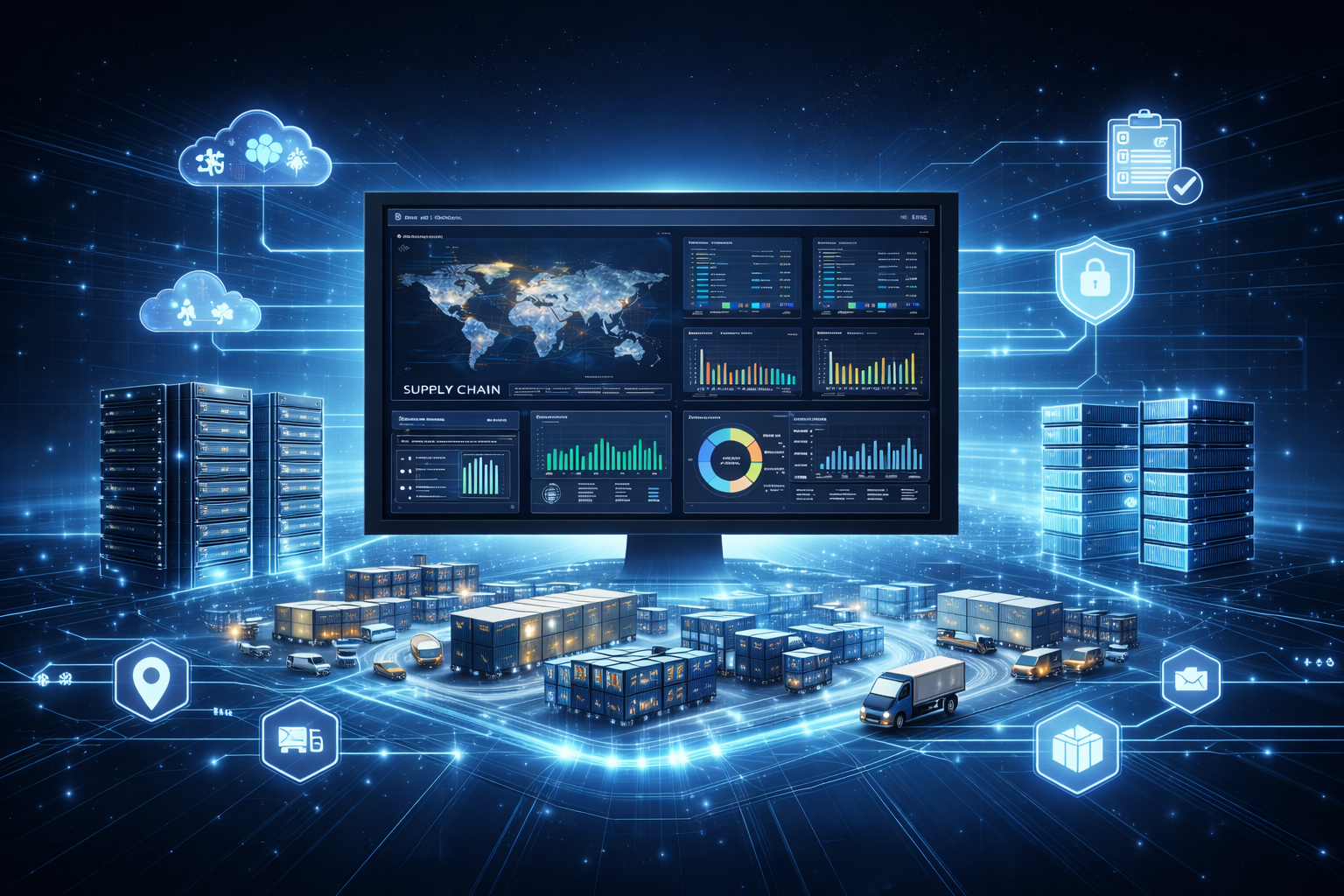
A supply chain control tower aggregates real-time data from warehouses, fleets, suppliers, and customs systems into a unified dashboard. Instead of fragmented visibility across multiple systems, decision-makers gain a live operational overview.
Event-driven integration ensures every operational change reflects instantly in dashboards and KPIs. For UK enterprises partnering with a cloud automation agency UK or logistics IT consultancy UK, building a control tower is often a key milestone in digital transformation.
Across these use cases, the pattern remains consistent: operational events trigger automated responses without delay. In the competitive UK logistics market, this responsiveness directly impacts cost efficiency, compliance readiness, and customer satisfaction.
Security & Compliance in UK Supply Chain Architecture
As UK logistics networks become more digitised, security is no longer just an IT responsibility — it is an operational safeguard. Every scanned pallet, GPS update, customs declaration, and supplier invoice generates sensitive data. When supply chains move to event-driven systems, that data flows continuously across services, partners, and cloud environments. The architectural shift toward real-time responsiveness must therefore be matched by equally robust security design.
In the UK, regulatory frameworks such as GDPR impose strict data handling requirements. Logistics firms processing customer delivery information, payment details, and cross-border shipment data must ensure encryption in transit, encryption at rest, and controlled identity access across all systems. Unlike legacy environments where data moved periodically, event-driven ecosystems transmit data instantly — increasing both visibility and risk exposure if not secured correctly.
Another complexity lies in integration. Modern supply chains depend on APIs connecting Warehouse Management Systems, Transport Management Systems, ERP platforms, customs authorities, and third-party carriers. Each integration point becomes a potential vulnerability if not protected through secure gateways, token-based authentication, and strict access validation. Organisations evaluating a cloud security company UK or cybersecurity consultancy UK typically prioritise secure API frameworks within their digital transformation roadmap.
Distributed cloud environments further expand the attack surface. With microservices running across multiple regions and cloud providers, traditional perimeter-based security models are insufficient. Zero-trust architecture — where every request is verified and continuously monitored — is increasingly becoming standard practice for UK logistics enterprises adopting event-driven infrastructure.
Resilience also plays a central role in compliance. High availability clusters, automated failover mechanisms, and Infrastructure as Code deployments ensure that operational continuity is maintained even during outages or cyber incidents. Companies engaging an event driven architecture company UK or supply chain digital transformation consultancy UK often view resilience engineering as essential not only for uptime, but also for regulatory accountability.
In a real-time supply chain, security cannot be bolted on later. It must be architected from the ground up — embedded within streaming pipelines, container orchestration layers, and integration gateways. For UK logistics leaders, secure architecture is not simply about avoiding breaches; it is about protecting operational trust across an increasingly interconnected ecosystem.
Cost Optimisation & Operational Resilience in UK Logistics Infrastructure
In the UK logistics sector, profitability depends on two things: controlled infrastructure costs and uninterrupted operations. Event-driven, cloud-native architectures help achieve both — but only when designed intentionally.
Traditional systems often require fixed provisioning to handle seasonal spikes such as Black Friday or Christmas fulfilment. This leads to idle infrastructure during normal months and performance strain during peak traffic. Modern containerised environments, managed through Kubernetes, scale automatically based on real-time event flow — preventing both over-spend and under-capacity.
Cost visibility is equally important. Real-time monitoring dashboards allow logistics leaders to track compute usage, event throughput, and system load continuously. Organisations engaging a cloud optimisation agency UK or infrastructure consultancy UK typically focus on building cost governance directly into architecture — not as an afterthought.
Resilience works alongside optimisation. Distributed clusters, replicated streaming platforms, and automated failover reduce the financial risk of downtime. For UK enterprises exploring an event driven architecture company UK or DevOps contractor UK logistics, resilience is measured in minutes of recovery — not days.
Cost vs Resilience Impact in Event-Driven Logistics Systems
| Architectural Approach | Cost Impact | Resilience Impact | Business Outcome |
|---|---|---|---|
| Static Infrastructure Provisioning | High idle cost during off-peak | Limited scalability | Reduced margin efficiency |
| Auto-Scaling Kubernetes Clusters | Pay-for-usage efficiency | Handles traffic spikes seamlessly | Predictable operational cost |
| Event-Driven Data Processing | Reduced compute overhead | Faster system response | Lower latency, lower spend |
| Multi-Region Cloud Deployment | Slightly higher baseline cost | High availability & disaster recovery | Revenue protection |
| Infrastructure as Code (Terraform) | Reduced manual maintenance cost | Rapid environment recovery | Operational consistency |
For UK logistics companies, cost optimisation is no longer about cutting infrastructure — it is about engineering elasticity. And resilience is not about redundancy alone — it is about architectural intelligence.